The Seep – From Davos Ideas to Canadian Reality
Part 1 exposed the WEF’s hypocrisy and internal scandals. But the bigger story is how their ideas are already changing the world—and hitting closest to home in Canada.
If Part one of this expose showed the rot inside the World Economic Forum—private jets, sex scandals, Schwab’s ousting amid fraud and abuse—then this part exposes the real long game: how their polished “brainstorming” has quietly become policy, reshaping economies, freedoms, and everyday life far beyond Davos. The WEF’s influence doesn’t stop at scandals or hypocrisy—it’s insidious, seeping into every walk of life through ideas that critics say are turning what were once labelled “conspiracy theories” into creeping reality. Phrases like “New World Order,” “Great Reset,” and especially “You will own nothing and be happy” get dismissed as fringe paranoia by mainstream outlets, but when you look closer, there’s a pattern: WEF-promoted concepts echo in real policies, economic shifts, and cultural narratives—often eroding individual freedoms and national priorities in ways that hit ordinary people hard.
The “Great Reset”—Klaus Schwab’s 2020 post-COVID initiative to “reinvent” capitalism around sustainability, equity, and “stakeholder” models—has been spun into claims of a tyrannical global takeover. Mainstream fact-checkers (Reuters, PolitiFact, BBC, USA Today) consistently rate the most extreme versions—forced property seizure, abolishing private ownership by 2030, or engineering a one-world communist order—as false or misleading.
They trace the infamous line “You will own nothing and be happy” to a 2016 speculative essay by Danish politician Ida Auken (published on the WEF site as a thought experiment on sharing economies), amplified in a 2018 WEF video as one possible future, not official policy. The WEF has repeatedly clarified it doesn’t advocate abolishing private property.
But here’s where skepticism kicks in: a lot of these debunkings come from fact-checkers tied to networks funded by the same globalist-adjacent players. The International Fact-Checking Network (IFCN) at Poynter (which certifies many outlets) has received grants from Open Society Foundations (George Soros-linked), Omidyar Network, and others. Bill Gates’ foundation has poured millions into media orgs (BBC, Reuters Institute) for health/climate reporting, overlapping with topics WEF critics tie to the Reset. Independent voices and critics argue this creates bias: fact-checkers downplay legitimate concerns about corporate influence while aggressively labelling dissent as conspiracy to protect aligned narratives.
When the debunkers are bankrolled by philanthropists with stakes in global agendas (climate, inequality, digital governance), is it any wonder they frame WEF ideas as benign while independents highlight the grain of truth? The WEF’s own language—multistakeholderism over national silos, circular/sharing economies, digital inclusion—fuels the perception that “New World Order”-style centralized control is seeping in, even if not through overt seizure.
In countries with WEF ties (via Young Global Leaders or Davos regulars), this shows up piecemeal:
· Subscription and access-over-ownership models booming (streaming, ride-sharing, leasing cars/appliances, “subscription furniture”)—aligning with Auken’s vision, driven by tech giants but echoing WEF sharing-economy enthusiasm.
· Net-zero/green policies making ownership costlier (carbon taxes, energy transitions) while promoting “circular” systems where you rent/repair/share instead of buy outright.
· Digital governance/ID explorations in WEF discussions (for inclusion, tracking emissions/finance)—critics see steps toward monitored access rather than true independence.
For everyday citizens, the seep feels real: rising costs from “sustainable” mandates (higher bills, green taxes), pressure toward renting amid inflation/debt, and growing digital controls that could limit personal assets and freedoms. Whether master plan or unintended elite overreach, the outcome is similar—top-down ideas reshaping life bottom-up, leaving people owning less, controlling less, and being told to be “happy” about the trade-offs.
Capitalism itself isn’t the villain here. When it’s allowed to function freely—real competition, voluntary exchange, entrepreneurs taking risks to serve consumers—it’s the single greatest engine of prosperity, innovation, and rising living standards humanity has ever seen. The problem isn’t markets; it’s when markets get hijacked by corporatism. That’s the version the WEF and its corporate partners quietly champion: monopolies and oligopolies cozying up to regulators, using “sustainability” and “stakeholder” rhetoric to lock in advantages, crush smaller competitors, and turn consumers into managed tenants rather than sovereign buyers. True free-market capitalism rewards the company that best serves the customer. WEF-style corporatism rewards the company that best serves the committee in Davos.
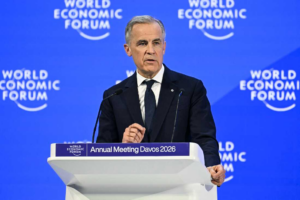
And there it is, Canadians—the quiet part said out loud, right in front of us. Just last month, in January 2026, Mark Carney—former Bank of Canada governor, Davos regular, and now a key Liberal figure—explicitly used the phrase “new world order” while striking a strategic partnership deal in Beijing. He described the agreement as positioning Canada “well for the new world order,” framing it as pragmatic adaptation to a shifting global landscape amid U.S. tariffs and fragmentation. His political predecessor, Justin Trudeau, went there even earlier: in a 2020 canned address to the nation, he openly welcomed the “Great Reset” as an opportunity to “reimagine” our economy and society. Both men—deeply plugged into Davos networks, both fluent in the WEF lexicon—let the mask slip in plain sight.
Yet here we are in 2026, still being told these are just harmless buzzwords, not blueprints. The same Liberal government—now led by the same technocratic class that cheered the Reset—continues to push top-down policies that make life more expensive, more surveilled, and less sovereign for ordinary Canadians: escalating carbon taxes, digital-ID pilots, net-zero mandates that punish working families while multinationals get the offsets, and endless “build back better” rhetoric that somehow always leaves regular people with less.
They didn’t hide it. They just counted on most Canadians not paying attention—or maybe being too polite to call it what it is.
The real reset isn’t coming from Davos, Beijing, or Ottawa boardrooms. It’s already underway—bottom-up, through voters waking up, pockets getting lighter, and people refusing to be told they’ll own less and like it. Canadians aren’t serfs in someone else’s “new world order.” Time to remind them who actually runs this country.
Sources / References
Greenpeace International, “One private jet flight for every four Davos participants” (Jan 15, 2026) – greenpeace.org
Greenpeace CEE report “Davos in the Sky” (Jan 2026) – greenpeace.at
New York Post, “Risky business: Sex workers demand soars in Davos during World Economic Forum” (Jan 24, 2026)
Daily Mail, “Secrets of the Davos sex workers serving global elite” (2025 report, patterns continuing)
Reuters, “World Economic Forum launches probe into founder Klaus Schwab over whistleblower allegations” (Apr 22, 2025)
Wall Street Journal, “The Unraveling of the King of Davos” (May 13, 2025)
Fortune, “World Economic Forum founder Klaus Schwab and his wife cashed in on Davos with over $1 million in questionable travel expenses” (Jul 23, 2025)
POLITICO, “WEF probe findings reportedly show Schwab manipulated competitiveness report” (Jul 20, 2025)
Swissinfo.ch, “Downfall in Davos: Klaus Schwab fights for legacy after WEF whistleblower claims” (May 15, 2025)
WEF official news release on probe findings (Aug 15, 2025) – weforum.org
(We welcome and encourage comments either below or on our social media posts!)
 0
0
 795
795
 20
20