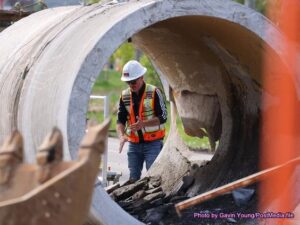
The Bearspaw South feeder main was built in 1975, and the belief at that time was that it would last up to 100 years. That was 50 years ago. In that half century, our understanding and technology have jumped by leaps and bounds, making it far more likely to build a pipe that actually would exceed 100 years compared to way back then.
This outdated optimism set the stage for decades of complacency. Engineers and planners in the mid-1970s couldn’t foresee how quickly material science would evolve: Today’s alternatives (e.g., ductile iron, welded steel with advanced coatings, or composite-reinforced pipes) incorporate better corrosion protection, real-time monitoring (like acoustic sensors or fiber optics), predictive analytics via AI-driven models, and rigorous soil/chemical testing. These advancements routinely deliver 100+ year lifespans with proactive maintenance, far surpassing the hit-or-miss performance of 1970s PCCP designs.
Yet Calgary stuck with the old pipe far too long, deferring critical inspections and replacements amid growth pressures and budget trade-offs. The result: catastrophic failures in 2024 and 2025, billions in costs, and ongoing restrictions for residents. This isn’t just bad luck—it’s a failure to adapt to better tools and knowledge that have been available for decades.
So why are Naheed Nenshi and Jyoti Gondek being held responsible? Because they were in the driver’s seat when the wheels came off—and they chose to keep their eyes on the rear-view mirror instead of the road ahead.
The Kiefer independent panel report (January 2026) may spread the blame across decades of “systemic failure” and a cozy “culture of deferral,” but let’s be blunt: leadership has consequences. Nenshi ran the show for eleven long years (2010–2021). Gondek sat on council through much of that period before taking the mayor’s chair (2021–2025). Both presided over the exact window when critical Bearspaw South feeder main inspection recommendations (2017, 2019/2020, 2022) were quietly shelved, budgets were redirected, and the pipe that carries 60% of Calgary’s treated water was allowed to rot.
The report may tiptoe around naming names, but the public isn’t buying the “no one person is to blame” line. When billions are on the line, water restrictions drag on for months, and families face another round of boil advisories after the second rupture in December 2025, people look to the people who held the top jobs. That’s Nenshi during the key deferral years, and Gondek when the pipe finally gave way.
And here’s the core of it: both prioritized looking good over being good
.
Nenshi spent his decade-plus chasing the progressive spotlight—Green Line LRT fantasies, endless public-art installations, the big blue ring nobody asked for, virtue-signaling equity reports, and photo-ops that played well on social media. Meanwhile, the unglamorous, expensive work of inspecting and replacing aging underground pipes got kicked down the road. He admitted himself that growth and new shiny projects took precedence over maintenance. That wasn’t an accident; it was a choice. And it was the wrong one.
Gondek, who rode Nenshi’s coattails onto council and then straight into the mayor’s office, kept the exact same playbook running. She inherited the deferral culture and did zilch to break it—in fact, she fed it. When the first rupture slammed the city in June 2024, the big response was more press conferences, finger-pointing at staff, and endless promises of “reviews” than any actual decisive action. The 2022 restructuring that made accountability even murkier? That happened squarely on her watch too.Optics first—real fixes later. Or never.
Why wasn’t the rest of the pipeline fully and aggressively inspected and replaced after that first disaster—especially when inspections already revealed hundreds of weak spots? Instead, tax dollars kept getting funnelled into failed “climate emergency” virtue-signaling schemes and anti-racism committees, grants, and DEI consultants that produced nothing but more bureaucracy, photo-ops, and feel-good reports while the pipes that actually keep the city running crumbled.
All that woke spending—on endless anti-racism task forces, equity audits, and “combatting racism” initiatives—did jack squat for the families now dealing with boil-water orders and skyrocketing repair bills. It was taxpayer money diverted from the unglamorous basics (pipes, redundancy, resilience) to pad the progressive resume and probably line a few connected pockets along the way.
This isn’t incompetence by accident. It’s a deliberate choice to prioritize looking enlightened over being effective. And Calgarians are still paying the price for it.
This isn’t about “systemic issues” excusing bad leadership. It’s about two mayors who preferred to be seen as forward-thinking visionaries rather than the boring, responsible stewards Calgary actually needed. They let woke priorities and feel-good projects crowd out the basics: water, pipes, redundancy, resilience.
The result is a city still scrambling, taxpayers on the hook for billions, and families wondering why their taps aren’t reliable in 2026.
Accountability starts at the top. Nenshi and Gondek were at the top. They own this mess.
Calgary deserves leaders who fix problems instead of polishing their image while the pipes burst. Unless Jeremy Farkas and an almost entirely new council are those leaders, we’ll keep paying the price for style over substance.
 0
0
 795
795
 20
20